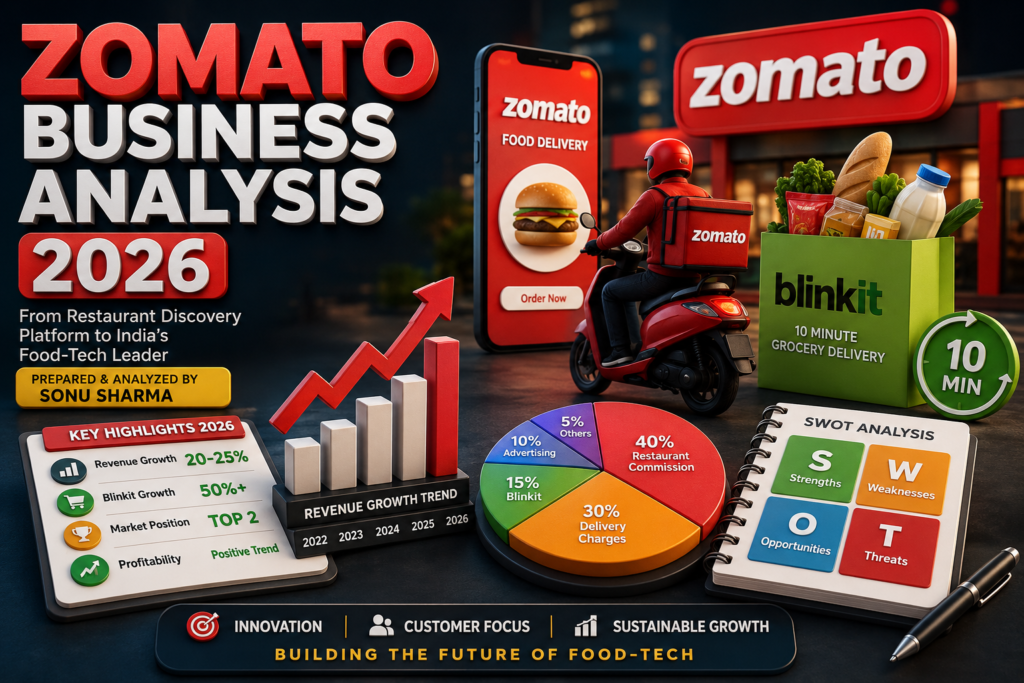
Prepared & Analyzed by Sonu Sharma
📌 STEP 1: Company Introduction
Introduction
Zomato is one of India’s leading food-tech companies. Founded in 2008 by Deepinder Goyal, the company initially started as a restaurant discovery and menu listing platform. Over time, it evolved into a full-scale food delivery ecosystem and later expanded into quick commerce through Blinkit.
Today, Zomato operates as a technology-driven platform connecting customers, restaurants, delivery partners, and grocery services.
Quick Facts
| Detail | Information |
|---|---|
| Company | Zomato |
| Founder | Deepinder Goyal |
| Founded | 2008 |
| Headquarters | Gurugram, India |
| Industry | Food Technology |
| IPO | 2021 |
| Major Business | Food Delivery & Quick Commerce |
| Growth Driver | Blinkit |
| Business Model | Marketplace Platform |
📌 STEP 2: Founder Story
How Zomato Started
Restaurant Menu Problem
↓
Deepinder Goyal noticed employees struggling to find restaurant menus
↓
Foodiebay Created
↓
Zomato Launch
↓
India Expansion
↓
Global Expansion
Analysis
The company was created to solve a simple but widespread customer problem—easy access to restaurant information and menus.This customer-first approach became the foundation of Zomato’s long-term success.
📌 STEP 3: Problem Solved by Zomato
Before Zomato
Customers
• No online menus
• No restaurant reviews
• Difficult restaurant discovery
• Limited information
After Zomato
Customers
↓
Zomato Platform
↓
Menus + Reviews + Ratings + Delivery
Result
✅ Better customer experience
✅ Increased restaurant visibility
✅ Faster decision making
✅ Convenient food ordering
📌 STEP 4: Business Model Analysis
How Zomato Makes Money
CUSTOMERS
↓
ZOMATO APP
↓
────────────────────────────
Restaurant Commission
Delivery Charges
Advertising Revenue
Hyperpure
Blinkit
────────────────────────────
↓
Revenue Generation
Revenue Sources
🥇 Restaurant Commission
🥈 Delivery Charges
🥉 Advertising Revenue
🏪 Hyperpure
🛒 Blinkit
💳 Subscription Services
📌 STEP 5: Growth Journey
Timeline
2008 🚀 Founded
2010 📱 Zomato Brand Established
2015 🌍 International Expansion
2021 📈 IPO Launch
2022 🛒 Blinkit Acquisition
2024 ⚡ Quick Commerce Expansion
2026 👑 Food-Tech Leader
Growth Analysis
Every phase introduced a new growth engine:
Restaurant Discovery
+
Food Delivery
+
Hyperpure
+
Blinkit
+
Technology Innovation
= Sustainable Growth
📌 STEP 6: Marketing Strategy
Customer Acquisition Engine
Social Media Marketing
+
Influencer Marketing
+
Performance Ads
+
Push Notifications
+
Brand Campaigns
=
Customer Growth
Why It Worked
• Humorous social media content
• Strong brand recall
• Regional campaigns
• Customer engagement
• Personalized recommendations
📌 STEP 7: Revenue Analysis
Revenue Distribution
Restaurant Commission ██████████
Delivery Charges ████████
Blinkit ███████
Advertising █████
Hyperpure ████
Subscription Services ███
Observation
Food delivery remains the core revenue stream.
However, Blinkit is rapidly becoming a significant contributor to overall revenue growth.
📌 STEP 8: Estimated 2026 Business Metrics
Key Performance Indicators
Revenue Growth (YoY)
↑ 20–25%
Blinkit Growth (YoY)
↑ 50%+
Order Volume
↑ Strong Growth
Market Position
Top 2 Food Delivery Platforms
Profitability
Positive Trend
Revenue Growth Trend
2022 ████
2023 ██████
2024 ████████
2025 ██████████
2026 ████████████
Analyst Insight
Zomato has shifted from aggressive expansion toward sustainable profitability by improving operational efficiency, reducing costs, and investing in high-growth verticals such as Blinkit and Hyperpure.
📌 STEP 9: Blinkit Deep Analysis
Blinkit – Zomato’s Second Growth Engine
Food Delivery
↓
Large Customer Base
↓
Blinkit Cross-Selling
↓
Higher Customer Spending
↓
Revenue Growth
Simple Explanation
A customer can use:
🍔 Zomato for food delivery
🛒 Blinkit for grocery delivery
This creates a complete ecosystem where one customer generates revenue across multiple services.
Strategic Advantage
One Customer
↓
Food Orders + Grocery Orders
↓
Higher Order Frequency
↓
Higher Lifetime Value
Why Blinkit Matters
✅ Faster growth than food delivery
✅ More customer touchpoints
✅ Increased order frequency
✅ Strong quick commerce positioning
✅ Better long-term profitability
📌 STEP 10: Profit vs Loss Analysis
Early Years
Revenue ███
Expenses ██████████
Profit ░░
Result: ❌ Loss
Reasons
• Customer acquisition cost
• Delivery network investments
• Expansion expenses
• Technology infrastructure spending
Current Position
Revenue ███████████
Expenses ████████
Profit █████
Result: ✅ Improved Profitability
📌 STEP 11: SWOT Analysis
Strengths
✅ Strong Brand Recognition
✅ Large Customer Base
✅ Advanced Technology Platform
✅ Strong Logistics Network
✅ Blinkit Ecosystem
Weaknesses
❌ High Competition
❌ Thin Margins
❌ Delivery Cost Pressure
❌ Dependence on Urban Markets
Opportunities
🚀 AI Integration
🚀 Blinkit Expansion
🚀 Tier-2 & Tier-3 Cities
🚀 Hyperlocal Commerce
🚀 New Revenue Streams
Threats
⚠ ONDC
⚠ Swiggy
⚠ Regulatory Changes
⚠ Price Wars
⚠ Rising Operational Costs
📌 STEP 12: Challenges Analysis
Key Challenges
Competition
+
Customer Retention
+
Delivery Costs
+
Regulatory Risks
+
Discount Dependency
Customer Retention Challenge
Food delivery has low switching costs.
Today:
Customer → Zomato
Tomorrow:
Discount Available → Swiggy
Therefore, customer retention remains one of the biggest strategic challenges.
Cost Challenge
Increasing fuel prices, delivery expenses, and logistics costs can directly impact profitability.
📌 STEP 13: Competitor Analysis
ZOMATO
│
├── Swiggy
├── ONDC
└── EatSure
Market Position
Zomato continues to be one of India’s strongest food delivery brands due to:
• Brand recognition
• Large user base
• Blinkit integration
• Strong technology ecosystem
📌 STEP 14: Current Position (2026)
Performance Meter
Brand Strength ██████████
Customer Reach ██████████
Profitability ████████░░
Innovation █████████░
Future Potential ██████████
Current Focus Areas
✅ Blinkit Growth
✅ AI Integration
✅ Cost Optimization
✅ Faster Deliveries
✅ Customer Retention
📌 STEP 15: Investment Perspective
Future Value Creation Drivers
Food Delivery
+
Blinkit
+
Hyperpure
+
AI Innovation
+
Operational Efficiency
=
Future Value Creation
Analyst View
✔ Strong Brand
✔ Growing Ecosystem
✔ Multiple Revenue Streams
✔ Expanding Quick Commerce Business
✔ Long-Term Growth Potential
📌 STEP 16: Future Roadmap
Food Delivery
↓
Blinkit Growth
↓
AI Recommendations
↓
Hyperlocal Commerce
↓
Future Expansion
Future Opportunities
🚀 Quick Commerce
🤖 AI Personalization
📦 Faster Logistics
🏪 Restaurant Ecosystem Growth
🌏 Expansion into New Markets
📌 STEP 17: Key Business Lessons
Real Problem Solving
+
Technology
+
Brand Building
+
Customer Focus
+
Long-Term Vision
=
Business Success
Lessons for Entrepreneurs
✔ Solve real customer problems
✔ Build scalable platforms
✔ Focus on brand building
✔ Diversify revenue streams
✔ Invest in technology
✔ Think long term
✔ Adapt to market changes
🎯 Final Conclusion
2008 🚀 Startup
2021 📈 IPO
2022 🛒 Blinkit Acquisition
2026 👑 Food-Tech Leader
Zomato is a powerful example of how technology, customer-centric innovation, and strategic diversification can transform a startup into a market-leading company The integration of Blinkit, investment in AI-driven experiences, and expansion into quick commerce have strengthened its ecosystem and positioned the company for long-term sustainable growth.For entrepreneurs and business analysts, Zomato demonstrates the importance of adaptability, innovation, ecosystem building, and long-term strategic thinking.