Sonu sharma: June 2026
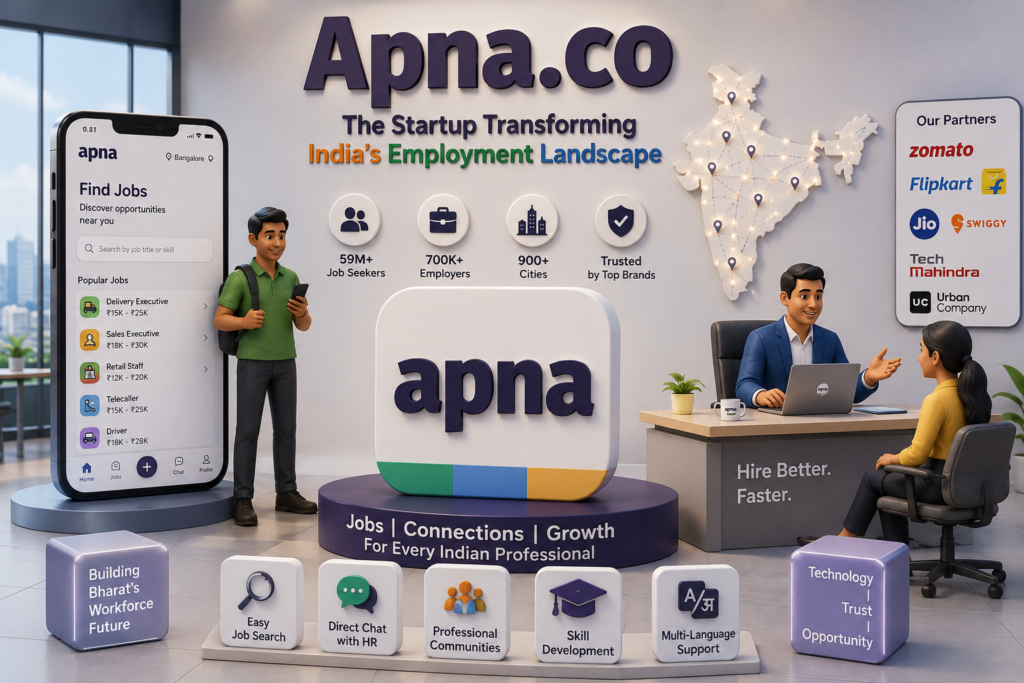
India’s job market has undergone a remarkable transformation over the last decade. While platforms such as LinkedIn have largely focused on white-collar professionals, a new generation of companies has emerged to serve the broader workforce that powers the country’s economy. Among them, Apna has established itself as one of the most influential players.Founded in 2019, Apna has grown from a startup with an ambitious vision into one of India’s largest employment and professional networking platforms. Its focus on blue-collar, grey-collar, and early-career workers has helped it build a unique position in a market that was often overlooked by traditional job platforms.
Understanding Apna’s Mission
Apna was founded in Bengaluru by entrepreneur Nirmit Parikh (along with co-founder Aryan Kenchin) with a simple yet powerful objective: make employment opportunities more accessible for India’s massive workforce.Unlike conventional professional networking platforms, Apna was designed for workers who often face challenges in accessing quality jobs, building professional networks, and connecting with verified employers. The platform offers a mobile-first experience and supports multiple Indian languages, making it easier for users from different backgrounds to participate in the digital economy.Over the years, the company has built an impressive ecosystem. Today, Apna serves more than 59 million registered job seekers and works with over 700,000 verified employers across India. Several well-known organizations, including Zomato, Flipkart, Jio, Swiggy, Urban Company, and Tech Mahindra, use the platform to hire talent at scale.What makes Apna particularly important is its focus on a segment that has historically received less attention from the technology industry. By helping workers discover opportunities and connect directly with employers, the company is attempting to bridge a critical gap in India’s labor market.
The Funding Story Behind the Unicorn
Apna’s growth has attracted significant investor interest.Since its launch, the company has raised approximately $194 million across multiple funding rounds. Its investor base includes some of the most respected names in venture capital, such as Tiger Global, Peak XV Partners (formerly Sequoia India), Lightspeed Venture Partners, Insight Partners, and GSV Ventures.A defining moment came in 2021 when Apna secured a $100 million Series C funding round led by Tiger Global. Following this investment, the company achieved unicorn status with a valuation of approximately $1.1 billion.Reaching a billion-dollar valuation within just a few years of launching placed Apna among India’s fastest-growing startups and highlighted the enormous potential investors saw in the employment technology sector.
Examining the Financial Performance
While growth and valuation often attract headlines, financial performance provides a more accurate picture of a company’s long-term prospects.Apna’s revenue showed strong growth from FY23 to FY24. Operating revenue increased from approximately ₹80 crore in FY23 to around ₹127.7 crore in FY24 — a significant improvement. However, in FY25, operating revenue declined approximately 4% to ₹122 crore, reflecting a dip primarily due to a fall in software development support revenue (down 31% to ₹63 crore). On the positive side, revenue from core recruitment solutions surged 61% to ₹57 crore in FY25.
Note: An earlier version of this article incorrectly stated that FY25 revenue grew by more than 50% year-on-year. In fact, overall operating revenue declined by 4% in FY25. The strong growth figure of 61% applied specifically to the recruitment solutions segment, not total revenue.
Equally important is the company’s effort to reduce losses. Net losses declined significantly from around ₹120 crore in FY23 to ₹51.3 crore in FY24, and further to ₹50.1 crore in FY25 — a marginal improvement of 2.3%.
These figures suggest a mixed picture: while the company has made strong progress in cutting losses and growing its core recruitment business, overall revenue growth has slowed. Achieving profitability remains a key challenge ahead.
BlueMachines.ai: Expanding Beyond Recruitment
One of the most interesting developments in Apna’s journey has been the launch of BlueMachines.ai in 2025.The platform focuses on enterprise-grade Voice AI solutions and enables businesses to deploy multilingual AI-powered voice agents for customer interactions. Organizations operating in sectors such as healthcare, insurance, lending, education, and recruitment have shown increasing interest in these capabilities.What attracted industry attention was the speed of adoption. Within approximately 45 days of launch, BlueMachines.ai reportedly secured enterprise contracts worth over $6 million, signaling strong demand for AI-driven communication tools in the Indian market.The platform’s strengths include support for multiple Indian languages, low-latency voice interactions, faster deployment timelines, and enterprise-scale implementation capabilities For Apna, this initiative represents more than just a new product. It signals the company’s ambition to evolve beyond job matching and become a broader workforce and AI technology platform.
Competitive Environment
Apna operates in a highly competitive market.Established players such as Naukri.com continue to dominate segments of the white-collar hiring market, while LinkedIn remains the global leader in professional networking. At the same time, companies like WorkIndia, Kaam24, and Vahan compete directly in blue-collar and gig-work recruitment.Despite this competition, Apna benefits from several advantages. Its large user base creates strong network effects, making the platform more valuable for both employers and job seekers. In addition, partnerships with government organizations — including the Labour Ministry and DPIIT — and skill-development initiatives help strengthen its credibility and reach.
As the platform grows, maintaining this competitive edge will be essential.
SWOT Analysis
Strengths
Apna has built a strong presence in India’s underserved workforce segment. Its extensive network of job seekers and employers, improving loss metrics, and strategic government partnerships provide a solid foundation for future growth. The 61% growth in recruitment solutions revenue in FY25 is a particularly encouraging sign for the core business.
Weaknesses
The company has yet to achieve profitability. Overall revenue declined in FY25, driven by a drop in software development support revenue. The absence of major recent funding rounds has also raised questions about future expansion plans and valuation growth.
Opportunities
India’s workforce continues to digitize rapidly, creating significant opportunities for employment platforms. The growth of Voice AI through BlueMachines.ai could also open substantial new revenue streams beyond recruitment.
Threats
Competition remains intense. Both domestic startups and global AI companies are investing aggressively in workforce technology and conversational AI solutions, increasing pressure on Apna to innovate continuously.
Looking Ahead
Apna now stands at an important stage in its evolution.
Its core recruitment business is showing strong segment-level growth, while its investment in artificial intelligence creates opportunities in entirely new markets. If the company can successfully scale both verticals and reverse the overall revenue decline, it has the potential to become one of India’s most influential workforce technology companies.The broader mission of improving access to employment remains highly relevant. Millions of workers across India continue to seek better career opportunities, and platforms that can efficiently connect talent with employers are likely to play a significant role in the country’s economic future.
Conclusion
In just a few years, Apna has grown from a young startup into a major force in India’s employment ecosystem. The company has demonstrated strong user growth, attracted leading investors, meaningfully cut losses, and expanded into emerging AI technologies.Questions about overall revenue growth, profitability, future fundraising, and a possible public listing remain open. However, one thing is clear: Apna has already established itself as a meaningful player in India’s workforce transformation story.As India’s digital economy continues to expand, the company’s next chapter will be closely watched by investors, employers, and job seekers alike.