By Sonu Sharma
When people think about Tata Motors today, they usually think about popular vehicles like the Nexon, Punch, Harrier, Safari, or perhaps the growing presence of Tata’s electric vehicles on Indian roads. What many people don’t realize is that the company’s journey has been anything but straightforward.Over the last 80 years, Tata Motors has transformed itself multiple times. It started as an engineering company, became India’s largest commercial vehicle manufacturer, entered the passenger car market, survived financial challenges, acquired global luxury brands, and eventually emerged as one of the key players in India’s electric vehicle revolution.The story of Tata Motors is not just about selling vehicles. It is a story of vision, patience, calculated risks, and the ability to adapt to changing market conditions.
The Early Years: Building the Foundation
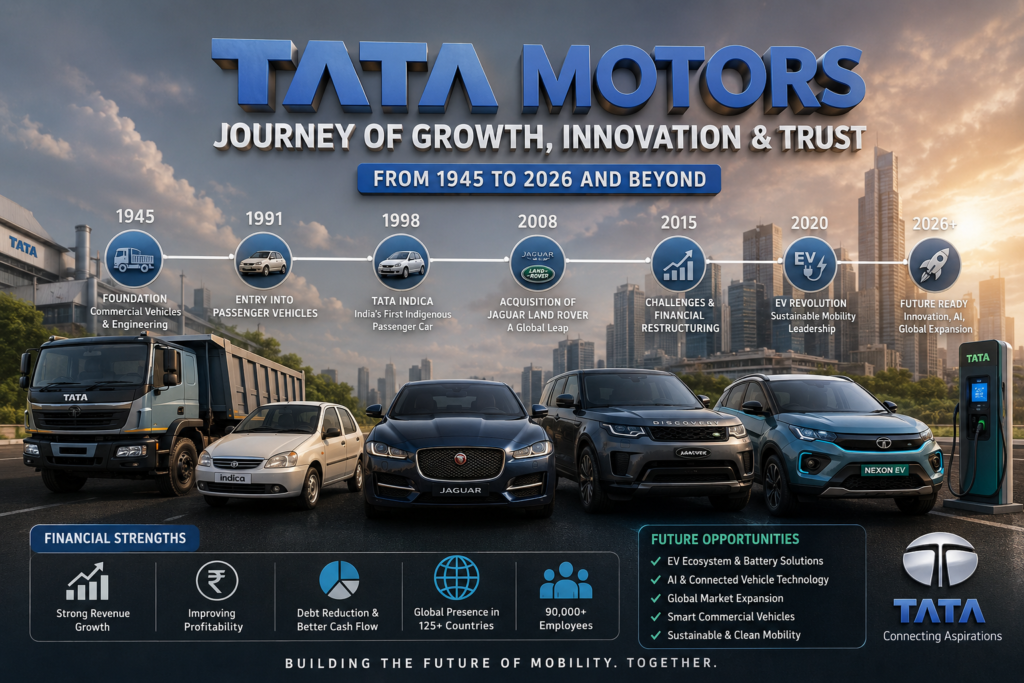
Tata Motors was established in 1945 as Tata Engineering and Locomotive Company (TELCO). In the beginning, the company focused on locomotives, engineering products, and commercial vehicles.India was still developing its infrastructure, and transportation needs were growing rapidly. Tata recognized this opportunity early and invested heavily in truck manufacturing. Its partnership with Daimler-Benz helped the company build technical expertise and improve product quality.By the 1980s, Tata trucks had become a backbone of India’s transportation industry. Whether it was construction materials, agricultural products, or industrial goods, Tata vehicles played a major role in moving the country’s economy.At that point, Tata Motors had already established itself as a trusted name in commercial transportation. However, the company wanted to achieve something much bigger.
The Move into Passenger Cars
The economic reforms of the 1990s changed India’s business landscape. Foreign brands entered the market, customer expectations evolved, and competition increased dramatically.Instead of remaining focused only on commercial vehicles, Tata Motors decided to enter the passenger vehicle segment.This was a bold move.Many experts believed competing against established automobile manufacturers would be difficult. Yet Tata Motors continued investing in product development.The launch of Tata Sierra, Tata Estate, and Tata Sumo helped the company gain experience. But the real breakthrough came in 1998 with the launch of the Tata Indica.The Indica was special because it was India’s first fully indigenous passenger car. It proved that an Indian company could design, develop, and manufacture a modern passenger vehicle.Although the early years were challenging, the Indica became an important milestone that helped Tata Motors establish its presence in the passenger vehicle market.
The Jaguar Land Rover Gamble
If there is one decision that completely changed the future of Tata Motors, it was the acquisition of Jaguar Land Rover (JLR) in 2008.At that time, Tata Motors purchased the luxury British brands from Ford. Many analysts questioned the decision. Some believed Tata was taking on too much risk by acquiring luxury brands during a period of global economic uncertainty.However, Tata Motors saw something that others did not.The acquisition gave the company access to world-class engineering, advanced automotive technology, premium customers, and a strong international presence.For the first time, Tata Motors was no longer just an Indian automobile manufacturer. It had become a global automotive company.The journey after the acquisition was not easy. Economic slowdowns, changing customer preferences, and weaker demand in key markets such as China created significant challenges. Debt levels increased, and profitability came under pressure.Yet the company remained committed to its long-term strategy.Looking back today, the JLR acquisition is widely regarded as one of the most important business decisions in Indian corporate history.
Learning from Failure: The Tata Nano Story
No discussion about Tata Motors is complete without mentioning the Tata Nano.The Nano was launched with the vision of providing affordable mobility to millions of Indian families. It attracted global attention because it was marketed as the world’s cheapest car.The idea was revolutionary.However, the market response did not match expectations.Many customers viewed the Nano as a budget vehicle rather than an aspirational product. Safety concerns and positioning challenges also affected demand.While the Nano was not a commercial success, it provided valuable lessons about consumer psychology, branding, and market positioning.In many ways, the experience helped Tata Motors make better strategic decisions in the years that followed.
The SUV Revolution
Perhaps the biggest turnaround in recent years has come from Tata Motors’ SUV strategy.The company recognized that customer preferences were shifting toward stylish, feature-rich, and safer vehicles.Products such as the Nexon, Harrier, Safari, Punch, and Curvv transformed the company’s image.Customers who once associated Tata primarily with trucks and commercial vehicles began viewing it as a modern automotive brand capable of competing with the best in the industry.The Nexon, in particular, became a major success story and helped strengthen Tata Motors’ position in the Indian passenger vehicle market.
Leading India’s Electric Vehicle Movement
While many automobile companies were still evaluating the future of electric mobility, Tata Motors decided to act.The company invested early in electric vehicle technology and launched products such as the Nexon EV, Tiago EV, Punch EV, and Tigor EV.This early-mover advantage helped Tata establish itself as one of the leading EV manufacturers in India.The importance of electric mobility cannot be overstated.Governments around the world are encouraging cleaner transportation solutions. Rising fuel prices, environmental concerns, and improvements in battery technology are accelerating EV adoption.As charging infrastructure expands and battery costs decline, electric vehicles are expected to become a much larger part of the global automobile market.Tata Motors is already in a strong position to benefit from this shift.
Financial Strengths That Support Future Growth
One of the biggest strengths of Tata Motors is the trust associated with the Tata brand.Customers often view Tata products as reliable, safe, and value-driven. This trust provides a competitive advantage that is difficult to replicate.The company also benefits from diversification.Unlike many automobile manufacturers that depend heavily on a single segment, Tata Motors operates across commercial vehicles, passenger vehicles, electric vehicles, and luxury automobiles through JLR.This diversified business model helps reduce risk and creates multiple growth opportunities.Another positive development has been the improvement in financial discipline. Over the last few years, the company has focused on reducing debt, improving operational efficiency, and strengthening cash flow generation.These improvements have enhanced the overall financial health of the business.
Challenges That Cannot Be Ignored
Despite its achievements, Tata Motors still faces significant challenges.Competition is becoming increasingly intense.Companies such as Maruti Suzuki, Mahindra, Hyundai, Toyota, Kia, and emerging EV players are all competing aggressively for market share.Raw material prices remain another concern. Steel, lithium, semiconductors, and other critical components can significantly affect profitability.The automobile industry is also highly sensitive to economic cycles. During periods of slower economic growth, vehicle demand can decline quickly.To remain competitive, Tata Motors must continue investing in innovation, technology, and customer experience.
Where Can Tata Motors Go from Here?
The next decade could be one of the most exciting periods in the company’s history.Electric vehicles will likely remain a major growth engine. However, the opportunity extends far beyond selling EVs.Tata Motors has the potential to build a complete mobility ecosystem that includes charging infrastructure, battery services, software platforms, and connected vehicle solutions.Artificial intelligence could also play a major role. Future vehicles may offer predictive maintenance, personalized driving experiences, intelligent navigation systems, and advanced safety technologies.Battery manufacturing represents another significant opportunity. By increasing control over battery production, Tata Motors could reduce costs and improve profitability.International markets such as Africa, Southeast Asia, and Latin America also offer substantial growth potential. Rising incomes and increasing urbanization in these regions could create strong demand for affordable and reliable vehicles.The commercial vehicle segment is likely to evolve as well. Fleet management systems, telematics, route optimization software, and AI-powered logistics solutions could create entirely new revenue streams.
Final Thoughts
The story of Tata Motors is ultimately a story of transformation.Few companies have successfully reinvented themselves as many times as Tata Motors has over the past eight decades. From trucks to passenger cars, from domestic operations to global expansion, and from traditional vehicles to electric mobility, the company has continuously adapted to changing market realities.There have been failures, setbacks, and difficult periods. Yet the company has repeatedly demonstrated resilience and a willingness to take bold decisions.As the automotive industry enters a new era defined by electric vehicles, artificial intelligence, software, and connected mobility, Tata Motors appears better positioned than ever before.The coming years will determine how far the company can go. But if history has taught us anything, it is that Tata Motors has never been afraid to evolve.And that may be its greatest strength of all.