Introduction
When people talk about India’s technology success stories, names like TCS, Infosys, and Wipro often dominate the conversation. However, one company has carved out a unique position in the global software industry without relying heavily on external funding or aggressive acquisitions. That company is Zoho.
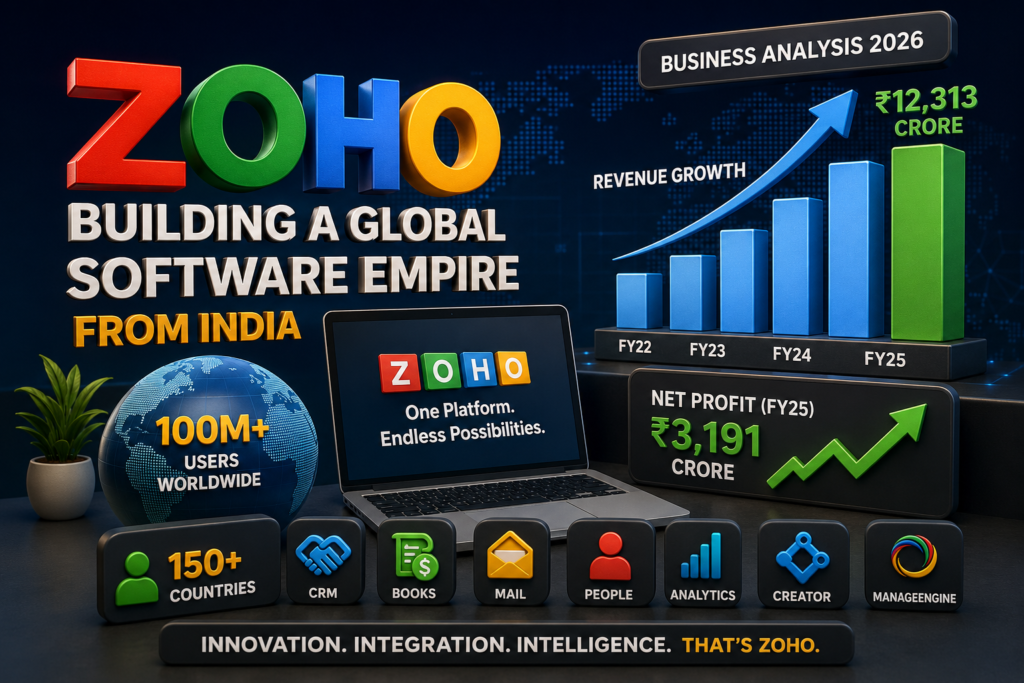
Today, Zoho serves more than 100 million users across over 150 countries, offering a wide range of cloud-based business applications. From customer relationship management and accounting software to human resource management and artificial intelligence solutions, Zoho has built a complete ecosystem designed to help businesses operate more efficiently.
What makes Zoho particularly remarkable is that it achieved this growth while remaining largely self-funded, proving that sustainable innovation can be just as powerful as venture capital-backed expansion.
The Beginning of Zoho’s Journey
Zoho’s story began in 1996 when Sridhar Vembu founded a company called AdventNet. Initially, the company focused on developing networking software and serving enterprise customers.
As the internet economy expanded and cloud computing started gaining traction, the company recognized a significant shift in how businesses would use software in the future. Instead of installing software on local systems, organizations increasingly preferred cloud-based solutions that could be accessed from anywhere.
This insight led to the launch of Zoho CRM in 2005, a milestone that transformed the company’s future. Over time, AdventNet evolved into Zoho Corporation, focusing entirely on cloud-based business applications.
Today, Zoho stands as one of the most respected names in the global Software-as-a-Service (SaaS) industry.
What Does Zoho Actually Do?
At its core, Zoho helps businesses manage and automate their daily operations.
Every organization needs to handle customer relationships, sales processes, employee management, accounting, communication, project tracking, and data analysis. Traditionally, companies purchased separate software for each of these functions.
Zoho simplified this challenge by creating an integrated ecosystem where all these functions can work together seamlessly.Because of this comprehensive approach, many industry experts describe Zoho as an “Operating System for Business.”
A Powerful Product Ecosystem
One of Zoho’s biggest competitive advantages is the breadth of its product portfolio.
The company offers more than 45 business applications covering almost every aspect of organizational management.
Some of its most popular products include:
- Zoho CRM
- Zoho Books
- Zoho Mail
- Zoho People
- Zoho Analytics
- Zoho Creator
- ManageEngine
Additionally, Zoho One combines multiple applications into a single unified platform, enabling businesses to manage operations from one ecosystem rather than using multiple vendors.
This integrated strategy has become one of the company’s strongest differentiators in a highly competitive market.
How Zoho Makes Money
Zoho operates on a Software-as-a-Service (SaaS) subscription model.
Customers pay monthly or annual fees to access its software products. This recurring revenue structure provides predictable cash flow and allows the company to continuously invest in innovation and product development.
Unlike many technology companies that depend heavily on advertising revenue or venture capital funding, Zoho’s business model is driven primarily by customer subscriptions and long-term relationships.
Financial Performance: A Story of Consistent Growth
The true strength of any business can often be measured through its financial performance.
Zoho’s numbers reveal a company that has maintained both growth and profitability over the years.
| Financial Year | Revenue | Net Profit |
|---|---|---|
| FY22 | ₹6,711 Crore | ₹2,387 Crore |
| FY23 | ₹8,703 Crore | ₹2,836 Crore |
| FY24 | ₹10,456 Crore | ₹3,299 Crore |
| FY25 | ₹12,313 Crore | ₹3,191 Crore |
Over just three years, Zoho nearly doubled its revenue while continuing to generate substantial profits.This level of growth is particularly impressive considering the company remains privately held and does not rely on external investors to fund expansion.
Understanding the FY25 Profit Decline
At first glance, Zoho’s slight decline in profit during FY25 may appear concerning. However, a deeper analysis tells a different story.While revenue increased significantly from ₹10,456 crore to ₹12,313 crore, net profit declined marginally from ₹3,299 crore to ₹3,191 crore.The primary reason behind this decrease was strategic investment.
Zoho significantly increased spending on:
- Artificial Intelligence research and development
- Cloud infrastructure expansion
- Data centers
- Product innovation
- Workforce growth
Rather than signaling weakness, these investments indicate that the company is preparing for the next phase of growth in an increasingly AI-driven technology landscape.
What Makes Zoho Different?
Several factors distinguish Zoho from its competitors.
1. Sustainable Growth
Unlike many technology startups, Zoho focused on profitability from an early stage rather than prioritizing valuation growth.
2. Affordable Solutions
Zoho’s products are often more cost-effective than competing offerings from larger software companies.
3. Integrated Ecosystem
Businesses can access CRM, accounting, HR, analytics, communication, and project management tools from a single provider.
4. Founder-Led Vision
Sridhar Vembu’s long-term approach has enabled the company to prioritize innovation and customer value over short-term financial targets.
The Competitive Landscape
Zoho operates in one of the most competitive industries in the world.Its major competitors include:
- Salesforce
- Microsoft
- Oracle
- HubSpot
Despite competing against companies with significantly larger resources and marketing budgets, Zoho has successfully built a loyal customer base through product quality, affordability, and continuous innovation.
Zoho’s Artificial Intelligence Strategy
Artificial Intelligence is rapidly transforming the software industry, and Zoho is positioning itself at the center of this transformation.The company’s AI platform, Zia, powers several intelligent features across its product ecosystem.
Zia helps businesses with:
- Predictive analytics
- Sales forecasting
- Customer insights
- Process automation
- Intelligent recommendations
As AI adoption accelerates globally, Zoho aims to integrate advanced intelligence into nearly every product it offers.
This strategy could become one of the company’s most important growth drivers over the next decade.
Looking Ahead: The Future of Zoho
Several global trends are working in Zoho’s favor:
- Increasing adoption of cloud computing
- Growing demand for AI-powered business software
- Rapid digital transformation among small and medium businesses
- Expansion of remote and hybrid work environments
- Rising demand for integrated software ecosystems
By continuing to invest in innovation while maintaining financial discipline, Zoho is well-positioned to strengthen its presence in international markets.Many analysts believe the company has the potential to become one of the world’s leading enterprise software providers in the coming years.
Final Thoughts
Zoho’s journey is more than just a business success story. It is a powerful example of how long-term vision, product innovation, and financial discipline can create sustainable growth.From its beginnings as a small networking software company to becoming a global SaaS leader, Zoho has consistently demonstrated that profitability and innovation can coexist.Today, the company stands as one of India’s most significant technology achievements, serving millions of users worldwide while continuing to invest in the future through artificial intelligence, cloud computing, and enterprise software innovation.If there is one lesson businesses can learn from Zoho, it is this:
Sustainable success is not built by chasing trends—it is built by solving real problems, creating lasting value, and thinking long term.
About the Author
Sonu Sharma
Business Researcher | Digital Marketing Enthusiast | Business Analysis & Strategy Writer