A Complete Business Analysis with Graphs and Case Studies
Introduction
Artificial Intelligence (AI) is no longer a futuristic technology. It has become a core part of modern digital marketing. Businesses of all sizes from startups to global corporations are using AI to improve customer targeting, automate repetitive tasks, create content, optimize advertisements, and increase sales.
In 2026, companies that successfully integrate AI into their marketing strategies are gaining a significant competitive advantage over businesses that rely solely on traditional marketing methods.
Step 1: Understanding AI Marketing
AI Marketing refers to the use of Artificial Intelligence technologies such as Machine Learning, Predictive Analytics, Natural Language Processing (NLP), and Automation Tools to improve marketing performance.
Main Objectives
- Increase Sales
- Reduce Marketing Costs
- Improve Customer Experience
- Automate Repetitive Tasks
- Generate Better ROI
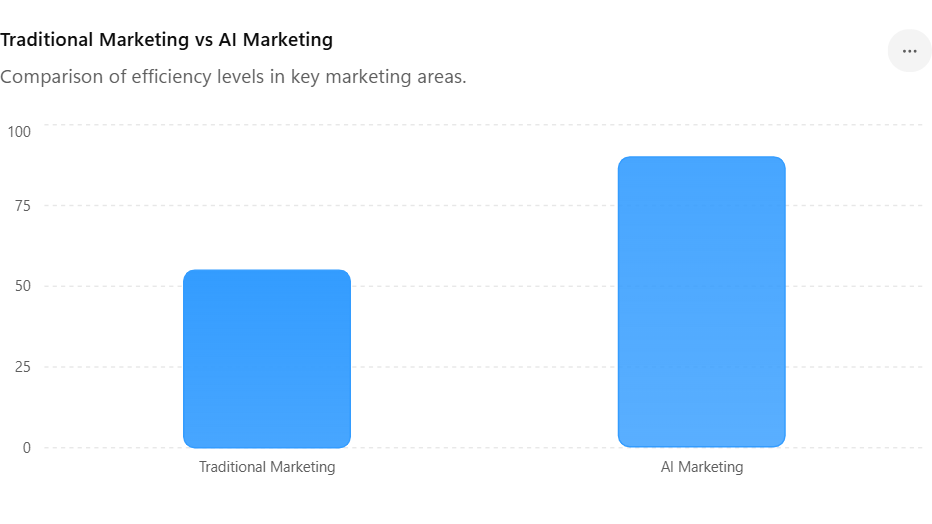
Step 2: Traditional Marketing vs AI Marketing
Analysis
Traditional marketing requires more human effort and time. AI marketing automates many processes, allowing businesses to make faster and more accurate decisions.
Step 3: Areas Where AI Is Changing Digital Marketing
1. Content Creation
AI tools can create:
- Blog articles
- Social media posts
- Product descriptions
- Email campaigns
- Video scripts
Popular AI Tools
- ChatGPT
- Gemini
- Claude
- Jasper AI
Business Impact
- Faster content production
- Reduced content creation costs
- Improved productivity
2. Search Engine Optimization (SEO)
AI helps marketers:
- Find profitable keywords
- Analyze competitors
- Optimize website content
- Predict search trends
Example
A company that previously spent 20 hours researching keywords can now complete the same task in less than 2 hours using AI tools.
3. Paid Advertising
Platforms such as:
- Google Ads
- Meta Ads
- LinkedIn Ads
use AI algorithms to optimize advertising campaigns.
AI Helps With:
- Audience targeting
- Budget allocation
- Ad placement
- Conversion optimization
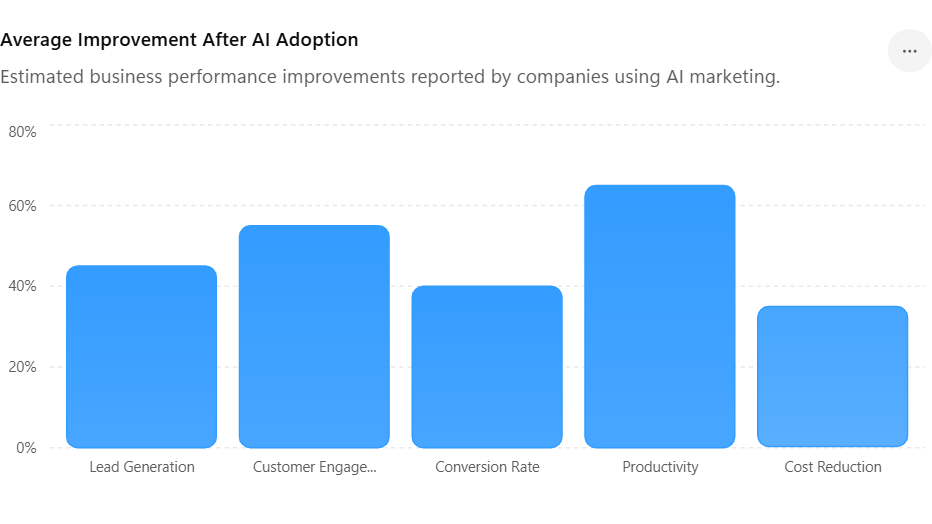
Step 4: AI Impact on Marketing Performance
Analysis
The chart shows that AI has the greatest impact on productivity and customer engagement. Businesses can achieve better results with fewer resources.
Step 5: Real Business Case Studies
Netflix
How Netflix Uses AI
Netflix analyzes:
- Watch history
- Search behavior
- Viewing preferences
AI then recommends personalized content.
Result
- Increased user engagement
- Higher customer retention
- More viewing hours
Amazon
How Amazon Uses AI
Amazon’s AI system:
- Recommends products
- Predicts customer purchases
- Optimizes pricing
Result
A significant percentage of Amazon’s sales come from AI-powered recommendation systems.
Spotify
How Spotify Uses AI
Spotify creates:
- Personalized playlists
- Music recommendations
- Listening trend analysis
Result
Users spend more time on the platform.
Step 6: AI Marketing Funnel
Awareness Stage
AI identifies potential customers.
↓
Interest Stage
AI recommends relevant content.
↓
Consideration Stage
AI shows personalized advertisements.
↓
Purchase Stage
AI optimizes offers and promotions.
↓
Retention Stage
AI improves customer loyalty through personalized communication.
Step 7: AI Marketing ROI Analysis
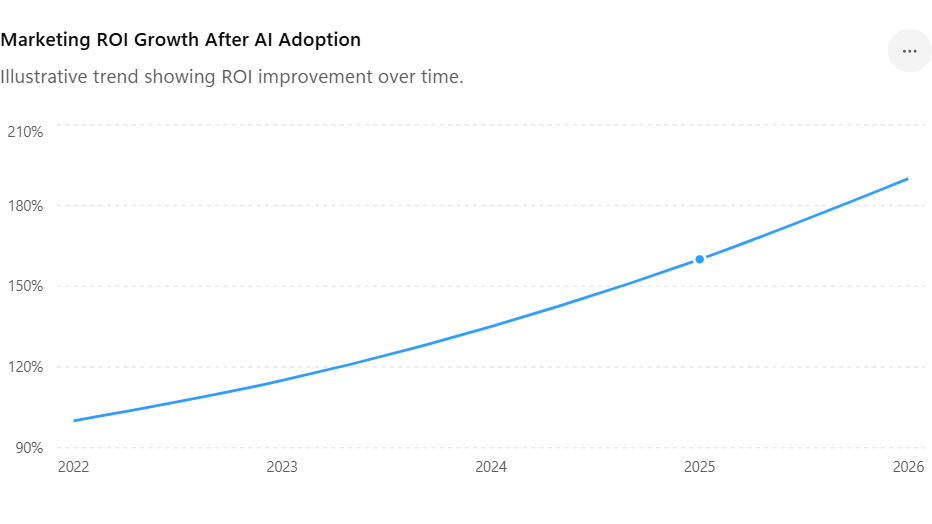
Analysis
As businesses improve their AI capabilities, marketing ROI generally increases because campaigns become more data-driven and efficient.
Step 8: Advantages of AI Marketing
1. Cost Reduction
Automation reduces manual workload.
2. Better Customer Targeting
AI identifies the right audience.
3. Faster Decision Making
Data analysis happens in seconds.
4. Personalized Experiences
Customers receive relevant recommendations.
5. Higher Productivity
Teams can focus on strategy rather than repetitive tasks.
Step 9: Challenges of AI Marketing
Data Privacy Concerns
Customer information must be protected.
AI Hallucinations
AI may generate inaccurate content.
Overdependence on Automation
Businesses still need human creativity.
Ethical Issues
AI-generated content must remain transparent and trustworthy.
Step 10: Future of AI Marketing (2026–2030)
Emerging Trends
- Hyper-Personalization
- AI Video Generation
- Voice Search Optimization
- Predictive Marketing
- AI-Powered Influencers
- Autonomous Advertising Systems
SWOT Analysis of AI Marketing
Strengths
- Automation
- Scalability
- Faster execution
- Better targeting
Weaknesses
- Dependence on data quality
- Lack of human creativity
Opportunities
- Global market expansion
- Personalized customer experiences
- Lower operational costs
Threats
- Privacy regulations
- Increased competition
- AI misuse
Conclusion
Artificial Intelligence is fundamentally changing digital marketing. From content creation and SEO to advertising and customer support, AI enables businesses to operate more efficiently and achieve better results. Companies that adopt AI strategically can reduce costs, improve customer experiences, and increase revenue. However, successful implementation requires balancing automation with human creativity and ethical considerations.
Key Takeaways
✔ AI reduces marketing costs
✔ AI improves customer targeting
✔ AI increases productivity
✔ AI enhances customer experience
✔ AI is becoming essential for future business growth
This structure is ready to be used directly as a professional blog article, internship report, or business analysis assignment.