Introduction
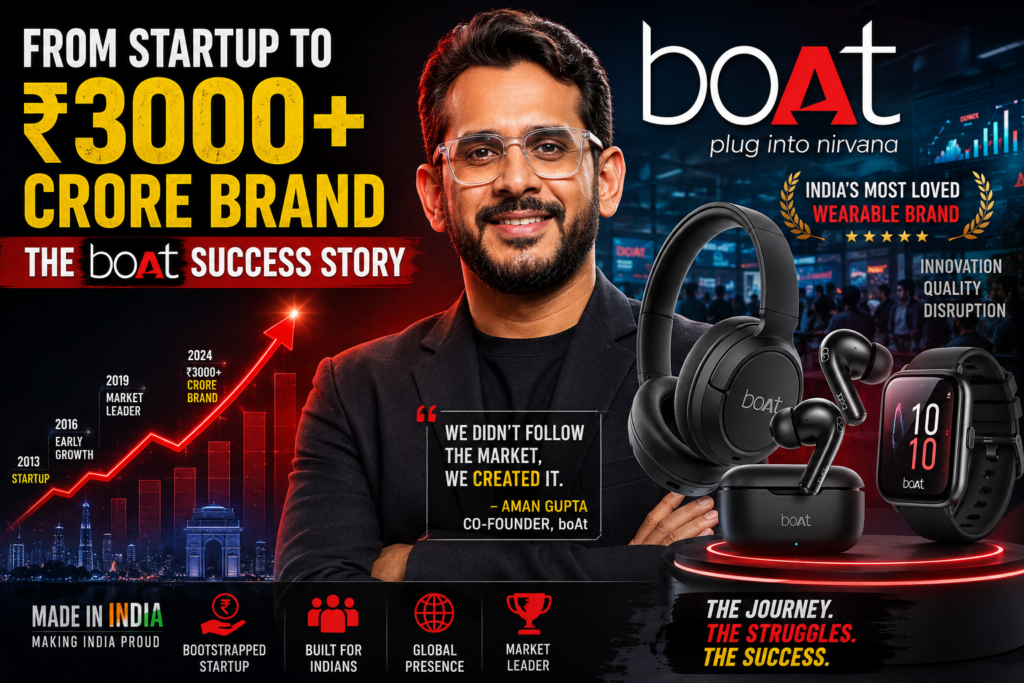
In the crowded landscape of Indian consumer electronics, few brands have captured the imagination of the youth as effectively as boAt (Imagine Marketing Ltd.). Founded in 2016, boAt transitioned from a niche audio accessory provider into a lifestyle icon. By positioning itself not just as a hardware manufacturer but as a purveyor of “Nirvana,” boAt disrupted the dominance of premium global giants and unorganized low-quality imports alike. This case study explores the strategic journey, marketing mastery, and current challenges of a brand that redefined the “Made in India” narrative for millennials and Gen Z.
1. Founders’ Background & Vision
The foundation of boAt lies in the complementary skills of its co-founders:
- Aman Gupta: An MBA graduate from the Indian School of Business (ISB) and a qualified Chartered Accountant, Aman brought deep financial and marketing acumen to the table. His corporate stints at Citi and KPMG, combined with his experience at Advanced Telemedia, gave him a keen eye for market gaps.
- Sameer Mehta: A veteran in the distribution and logistics space, Sameer provided the operational backbone required to scale a hardware business. His understanding of supply chain logistics was critical in navigating the complexities of the Indian electronics market.
Vision: They didn’t want to build just another “gadget” company. They aimed to create a lifestyle brand one that felt as trendy as a fashion label and as reliable as a premium audio device.
2. Problem Identification & Market Opportunity
Before 2016, the Indian audio market was polarized:
- The Premium Segment: Dominated by brands like JBL, Sony, and Bose, which were high-quality but prohibitively expensive for the average Indian student.
- The Unorganized Segment: Flooded with cheap, low-quality Chinese imports that lacked durability, warranty, and brand trust.
The Pain Point: Customers were tired of “use and throw” cables and earphones that broke within a month. There was a glaring void for “affordable luxury” products that looked premium, sounded decent, and were priced for the price-sensitive but aspiration-driven Indian youth.
3. Business Idea & Launch
boAt began with a simple product: a durable braided charging cable. Aman Gupta realized that iPhone users frequently dealt with frayed chargers. By focusing on durability, they built immediate trust.
- Initial Investment: Approximately ₹30 lakh from personal savings and family.
- Strategy: They bypassed expensive brick-and-mortar retail initially, choosing an “Online-First” model via Amazon and Flipkart to keep overheads low and reach pan-India.
4. Business Model & Strategy
Direct-to-Consumer (D2C) & Hybrid Distribution
boAt utilized a hybrid D2C model. While they heavily leveraged marketplaces (Amazon/Flipkart) for volume, they prioritized their own website to collect consumer data and control the brand narrative. This allowed them to pivot quickly based on user feedback.
Marketing Mastery
- The “boAthead” Community: They built a tribe. By calling their customers “boAtheads,” they fostered a sense of belonging.
- Influencer & Celebrity Marketing: Instead of traditional TV ads, they partnered with cricket stars (Hardik Pandya, Shikhar Dhawan) and Bollywood actors (Kiara Advani, Kartik Aaryan). This aligned the brand with “cool” icons.
- Digital-First Campaigns: Campaigns like “Plugging into Nirvana” became synonymous with an escapist, youthful lifestyle.
5. Product Strategy & Diversification
boAt successfully executed a “Fast Follower” strategy. Instead of waiting years to innovate, they identified trending features (e.g., Active Noise Cancellation, IPX water resistance) and brought them to the mass market quickly.
- Audio: Wired earphones, TWS (True Wireless Stereo), and Bluetooth speakers.
- Wearables: Entry into smartwatches capitalized on the health-tracking trend.
- Gaming: Launching specialized gaming headsets to tap into India’s burgeoning e-sports scene.
6. SWOT Analysis
| Strengths | Weaknesses |
| Strong brand recall among Gen Z | High dependency on third-party manufacturing |
| Affordable “premium” positioning | Lower profit margins due to competitive pricing |
| Massive community engagement | Limited R&D compared to global giants |
| Opportunities | Threats |
| Expansion into AI-powered wearables | Market saturation and intense competition |
| International market entry | Price wars from Chinese budget brands |
| Offline retail penetration | Shifts in consumer preference for premium tech |
7. Financial Growth Analysis
Estimated Revenue Growth
| Year | Revenue |
|---|---|
| 2018 | ₹27 Crore |
| 2019 | ₹108 Crore |
| 2020 | ₹500+ Crore |
| 2021 | ₹1500+ Crore |
| 2022 | ₹2800+ Crore |
| 2024 | ₹3300+ Crore |
Key Observation
The company demonstrated exceptional growth due to:
- Effective branding
- Rising smartphone penetration
- Affordable pricing
- Strong online sales
8. Competitive Landscape (2026 Perspective)
The market is no longer a vacuum. boAt now competes with:
- Global Giants: Sony and JBL (maintaining premium perception).
- Local Rivals: Noise and Fire-Boltt (direct competition in the affordable smartwatch/TWS space).
- Smartphone Brands: Realme and Xiaomi (bundling audio/wearables with their phone ecosystem).
9. Competitor Analysis
| Brand | Strength | Weakness |
| boAt | Branding + Price | Lower innovation |
| Sony | Premium quality | Expensive |
| JBL | Strong audio reputation | Premium pricing |
| Noise | Smartwatch leadership | Lower brand loyalty |
| Fire-Boltt | Budget products | Intense competition |
| Xiaomi | Ecosystem advantage | Limited premium perception |
Competitive Advantage
boAt’s biggest advantage is its ability to combine:
- Brand identity
- Design
- Affordability
- Marketing
10. Business Analyst’s Perspective
As of 2026, boAt is at a critical juncture. Having scaled rapidly, the company is now grappling with the transition from “hyper-growth” to “sustainable profitability.” The recent dip in revenue growth reflects the intense price wars in the Indian market. The brand’s move to focus on professionalizing its governance and the strategic decision for founders to transition roles suggest a preparation for a more mature corporate phase (IPO readiness).
Insight: boAt’s true “moat” was never just the hardware; it was the brand identity. In a commodity market, they sold “coolness” alongside sound. However, as the market matures, they must shift from being a “re-brander” of imported tech to a true innovation house to survive the next decade.
11. Key Lessons for Startups
- Community Over Customers: Build a tribe, not just a transaction log.
- Agility is Key: In consumer tech, being first to market with a decent product often beats being last to market with a perfect one.
- Brand is a Pricing Insulator: If your brand is strong, customers will pay a small premium over generic unbranded alternatives.
- Know When to Pivot: boAt started with cables and pivoted to audio, then wearables staying stagnant is the death of a startup.
12. Conclusion
boAt’s journey is a quintessential Indian startup success story. They took a mundane product category, injected it with marketing flair, and scaled it through a digital-first approach. While they face significant headwinds in 2026 ranging from market saturation to margin pressures their ability to remain “relatable” to the Indian youth remains their strongest asset. Whether they can evolve into a global consumer technology powerhouse will depend on their ability to innovate beyond the assembly line.