1. Executive Summary
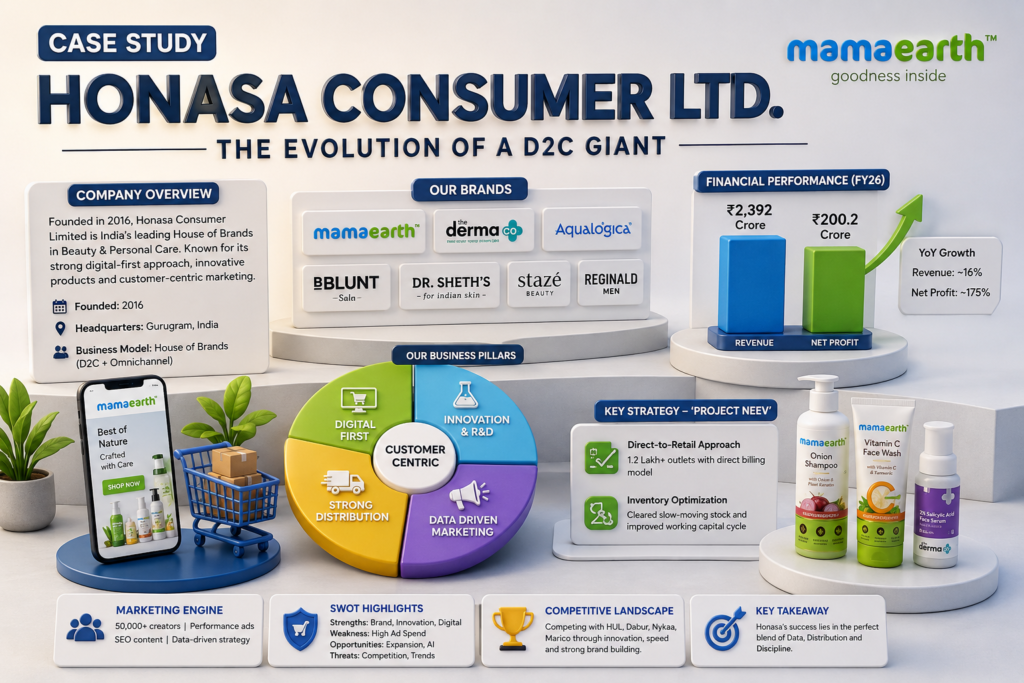
Honasa Consumer Limited (the parent company of Mamaearth) has moved from being a niche ‘baby-care’ startup in 2016 to becoming India’s leading House of Brands (HoB). By dominating the skincare, haircare, and cosmetics landscape, the company has successfully transitioned from a “Growth-at-all-costs” model to a “Profitable Growth” model, as evidenced by their remarkable FY26 results.
2. The Foundation: A Founder’s Insight
The journey began with a personal problem. Varun Alagh (Ex-HUL) and Ghazal Alagh (Artist) couldn’t find “chemical-free” products for their son. They identified a massive gap: Indian parents are willing to pay a premium for safety. This insight led to the creation of Mamaearth’s “Toxin-Free” brand positioning, which they later scaled across skincare and haircare.
3. Business Model: The “House of Brands” Framework
Honasa operates on a “Digital-First” strategy, capturing diverse consumer segments through specific brand identities:
- Mamaearth: Mass-premium natural segment.
- The Derma Co.: Ingredient-led, science-backed skincare.
- Aqualogica: Hydration-based premium skincare.
- BBlunt & Dr. Sheth’s: Strategic acquisitions for niche expertise (Hair & Dermatology).
- Staze & Reginald: Experimental entries into cosmetics and men’s grooming.
4. Financial Analysis (FY26 Audited Data)
The transition from a ‘burning startup’ to a ‘dividend-paying corporate’ is the most significant milestone in Honasa’s history.
| Metric | FY26 Value | Significance |
| Operating Revenue | ₹2,392 Crore | ~16% YoY Growth |
| Net Profit (PAT) | ₹200.2 Crore | ~175% YoY Growth |
| Dividend | ₹3/share | Signals financial maturity |
| Debt-to-Equity | Very Low | Asset-light business model |
5. Operational Pivot: “Project Neev”
In 2024-25, Honasa faced distribution hurdles and inventory pile-ups. They responded with Project Neev:
- Direct-to-Retail: Reduced reliance on distributors by establishing direct billing with 1.2 lakh+ outlets.
- Inventory Optimization: Cleaned up ‘slow-moving’ stock to focus on fresh cycles, significantly improving working capital.
6. The “Digital-First” Marketing Engine
Mamaearth’s success is built on a “Marketing Physics” model:
- Influencer Trust: Engagement with 50,000+ creators, leveraging micro-influencers to build authentic brand recall.
- Data-Driven Performance: Precision bidding on Google/Meta/Amazon to optimize Customer Acquisition Cost (CAC).
- Organic Moat: SEO dominance on high-volume search terms like ‘Hair Fall Solutions’ or ‘Sunscreen Guide’.
7. Strategic SWOT Analysis
- Strengths: Strong brand recall, data-driven R&D, and direct-to-retail network.
- Weaknesses: High dependence on advertising spend (A&P).
- Opportunities: Expansion into Tier 2/3 markets and AI-based personalized skin diagnostics.
- Threats: Aggressive pricing from incumbents (HUL, Marico) and quick-commerce delivery disruption.
8. Key Lessons for Business Strategy
- Cross-Selling (CAC to LTV): Acquire customers through Mamaearth, then drive Lifetime Value (LTV) by cross-selling products from The Derma Co. or BBlunt.
- Agility: While traditional giants take years, Honasa maintains a 3-6 month time-to-market for new trends (e.g., Vitamin C, Salicylic Acid).
- Governance: Post-IPO, the emphasis on transparency has been a cornerstone for building investor confidence.
Appendix: Understanding the D2C Revolution
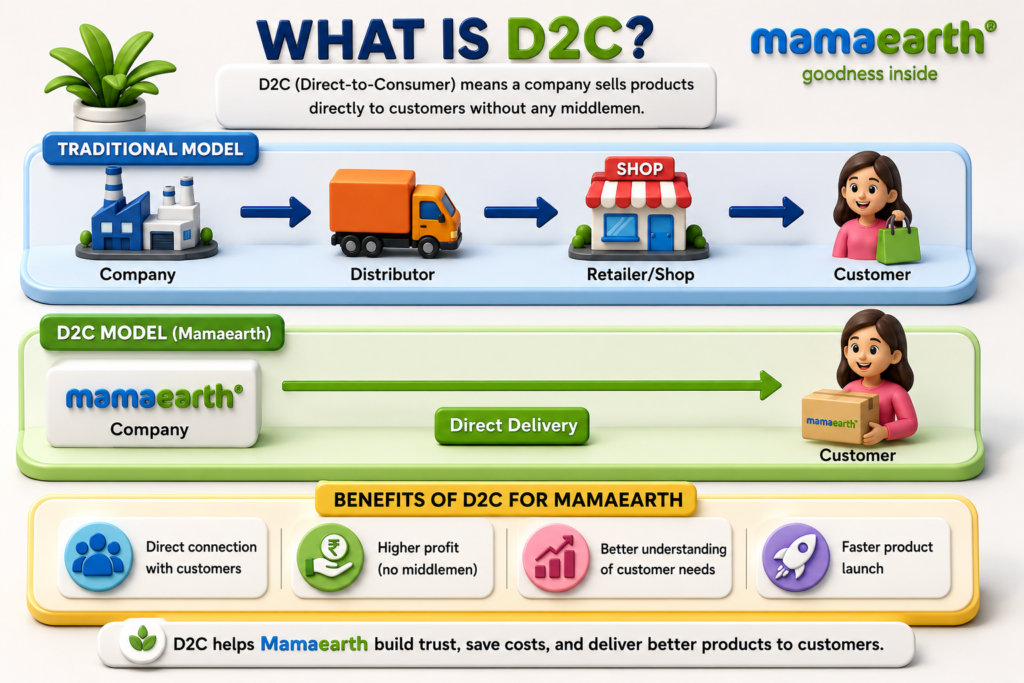
For readers unfamiliar with the model, D2C (Direct-to-Consumer) simplifies the retail process:
- The Old Way (Traditional): Factory $rightarrow$ Distributor $rightarrow$ Wholesaler $rightarrow$ Retailer $rightarrow$ Customer. (High cost, lost data).
- The D2C Way: Factory $rightarrow$ Digital Platform $rightarrow$ Customer.
Why D2C Wins:
- Direct Connection: No middleman.
- Data Ownership: Brands know exactly what the customer likes/dislikes.
- Feedback Loop: Traditional firms take months to analyze trends; D2C brands adapt in clicks based on real-time reviews.
Conclusion
Honasa Consumer Ltd. has written a new playbook for the Indian beauty market. Their FY26 performance is a classic study in a “Profitable Turnaround.” The success of the company isn’t just in their products—it lies in the perfect blend of data, distribution discipline, and brand agility.
Bibliography & References:
- Strategic Management Insights from Management Interviews (2026).
- Honasa Consumer Ltd. Investor Relations: Q4 FY26 Results.
- SEBI/NSE Quarterly Financial Disclosures (2026).
- Nielsen Consumer Trends: BPC Sector (2026).